
Jawapan pantas: Insulated bottle lid design should be evaluated as a complete system of threads, gasket, vent, straw or spout, lock, handle and materials. A good lid closes consistently, resists leakage under the intended conditions, can be cleaned and reassembled, and has replaceable wear parts where commercially practical.
This guide is for brands and distributors choosing lids for custom or Diller-branded insulated bottles.
Insulated bottle lid design: key takeaways
- Match the lid to the user and beverage.
- Test leakage after repeated assembly and use.
- Inspect gasket retention and cleaning access.
- Check handle, lock and hinge durability.
- Plan replacement parts and instructions.
Choose the right drinking mode
A screw cap can provide simplicity, while a flip spout supports one-handed use. Straw lids, cup lids and dual-drink systems solve other needs but add components and cleaning steps. Select the experience that fits the target customer rather than adding features for appearance alone.
| Lid type | Main benefit | Semakan pembeli |
|---|---|---|
| Screw cap | Simple closure | Thread engagement and gasket seating |
| Flip spout | Quick access | Lock, hinge and vent |
| Straw lid | Upright drinking | Flow, tube fit and cleaning |
| Cup lid | Pour-and-drink use | Outer cap sealing and comfort |
| Dual mode | More than one drinking option | Complexity and misuse resistance |
Define a realistic leakage test
Specify fill level, liquid temperature, closure force, orientation, shaking or movement and test time. Test new lids and lids after repeated cycles. Carbonated drinks or hot liquids may create pressure and require product-specific restrictions.
Leak-proof claims should match actual intended use. A sipping opening may resist normal movement without being designed for unrestricted inversion inside a bag.
Inspect cleaning and reassembly
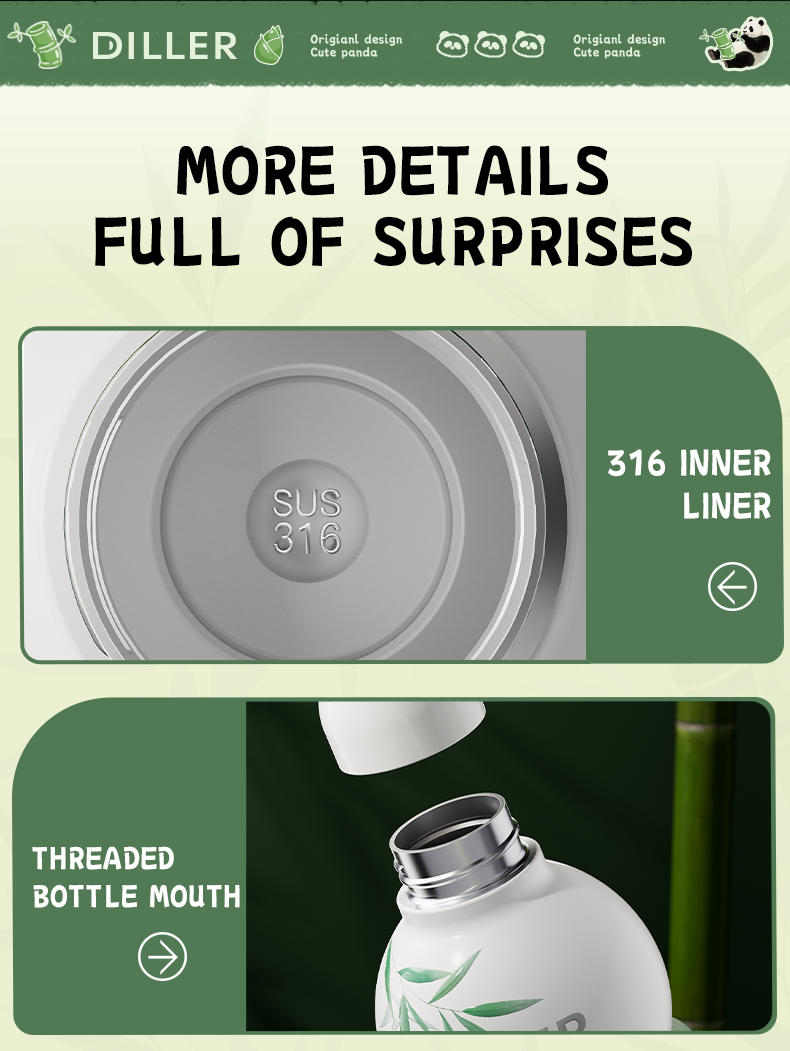
Look for hidden channels, removable gaskets and small parts. Instructions should show how to disassemble, clean and reinstall components without stretching or reversing seals. A design that is easy to open but difficult to clean can create complaints.
Plan component quality and after-sales support
Record gasket material, colour, dimensions and assembly. Confirm whether replacement lids, straws and seals can be supplied and how long the version is expected to remain available. Distributor service can become a brand advantage when a small part does not force replacement of the full bottle.
How Diller develops lid-led innovation
Diller’s innovation advantage includes structures and user scenarios as well as visual design. Through its brand + supply chain + factory model, Diller can evaluate an existing lid, component customisation or deeper OEM/ODM development. Any patent or exclusive-design status must be confirmed for the exact model and territory.
Lid sample test checklist
- Close the lid with different realistic user forces and positions.
- Test upright, side and inverted orientations as intended.
- Repeat opening, closing, locking and handle cycles.
- Remove and reinstall gaskets according to the instructions.
- Check drinking flow, venting, splashing and residual liquid.
- Inspect small parts for secure retention and cleaning access.
- Test the lid on every body with which it will be sold.
- Record any beverage or temperature restrictions in the content.
Ask several users to perform the same tasks without coaching. If they repeatedly assemble a gasket incorrectly or cannot identify the locked position, the issue may be design or instruction related. Improve the system before relying on after-sales explanations.
Soalan lazim
Is a more complex lid always more innovative?
No. Innovation should solve a useful problem without creating disproportionate leakage, cleaning or durability risk. Simplicity can be a strong design advantage.
Can the same lid fit multiple bottle bodies?
Sometimes, if thread, sealing geometry and dimensions are compatible. Confirm fit and leakage on every intended body rather than assuming interchangeability.
Should a hot-water bottle use a straw lid?
Use only as specifically designed and instructed. Hot liquids can create burn and pressure risks, so intended temperature and drinking mode require careful review.
Make the lid part of the quality specification
Insulated bottle lid design affects nearly every use cycle. Select it around real behaviour, prove sealing and durability, and support customers with clear cleaning and replacement guidance.
Layari Diller insulated bottle designs atau discuss a lid-led OEM project.