
Regulamento da UE sobre Contacto com Alimentos: 1935/2004 e 10/2011
If you are sourcing water bottle certifications from China for export to the US, EU, or other markets, understanding the regulatory landscape is not optional — it is the foundation of your entire product compliance strategy. Selling non-compliant water bottles can result in customs seizure, product recalls, legal liability, and irreversible damage to your brand reputation.
More importantly, certifications are a trust signal. Retailers, distributors, and end consumers increasingly check for FDA, LFGB, or EU compliance before placing orders. Therefore, a water bottle that cannot prove its safety credentials will lose the sale, no matter how competitive the price.
This guide covers the three most critical certification frameworks for water bottles exported from China: the US FDA system, o EU Food Contact Regulatione Germany’s LFGB standard. Each section explains what the regulation covers, what your factory must do to comply, and how to verify the certification is genuine.
US FDA Food Contact Certification for Water Bottles
O US Food and Drug Administration (FDA) regulates food contact materials under the Federal Food, Drug, and Cosmetic Act. Water bottles that contact beverages intended for human consumption are classified as Food Contact Substances (FCS).
What FDA Regulation Covers
The primary FDA regulations governing water bottles include:
- 21 CFR Part 175.300: Coating and adhesive regulations — applies to water bottles with internal powder coatings or epoxy linings
- 21 CFR Part 177: Plastic materials — applies to Tritan, PP, PE, PC, and other plastic water bottle components
- 21 CFR Part 178: Adjuvant substances — covers substances used in the manufacture of food contact materials
For stainless steel water bottles, the relevant standard is 21 CFR 175.300, which requires testing for:
- Water extractives: Tested using deionized water immersion
- 8% alcohol extractives: Simulates alcoholic beverage contact
- n-heptane extractives: Simulates fatty food contact (for bottles used with oils or fatty beverages)
Does FDA Require Registration?
A common misconception is that water bottle manufacturers must register with the FDA before exporting. In fact, the FDA does not require pre-market registration for food contact materials. However, the materials and substances used must comply with the applicable CFR regulations.
In practice, this means your China factory must:
- Use only FDA-approved materials (e.g., 304 stainless steel grade, food-grade Tritan)
- Conduct extractive testing at an FDA-recognized laboratory
- Provide a Certificate of Compliance ou Test Report confirming the bottles meet 21 CFR standards
FCN (Food Contact Notification)
For new or novel food contact substances not already listed in 21 CFR, manufacturers must file a Food Contact Notification (FCN) with the FDA. If your water bottle uses a proprietary coating or additive, verify whether an FCN exists or if one is required. For standard stainless steel bottles using 304 or 316 stainless, existing FDA regulations typically cover the materials without requiring an FCN.
EU Food Contact Regulation: 1935/2004 and 10/2011
Juntas de vedação e anéis O Regulation (EC) No 1935/2004, the framework regulation for all food contact materials in the EU, and Regulation (EU) No 10/2011, which specifically governs plastic materials. Furthermore, these regulations apply uniformly across all 27 EU member states.
Regulation (EC) No 1935/2004: The EU Framework
This regulation, in force since October 2006, establishes the core principle that all food contact materials must be sufficiently inert to prevent substances from transferring to food in quantities that could:
- Endanger human health
- Bring about an unacceptable change in the food’s composition
- Cause a deterioration in the organoleptic characteristics (taste or odor) of the food
The regulation applies to all 27 EU member states and requires that materials carry appropriate marking (typically a food fork-and-glass symbol or “for food contact” declaration) and be traceable throughout the supply chain.
Regulation (EU) No 10/2011: Plastic Materials
For water bottles made with plastic components — including Tritan, PP, or PE — Regulation (EU) No 10/2011 sets detailed requirements including:
- Overall Migration Limit (OML): Maximum 60 mg of substances per kg of food (mg/kg)
- Specific Migration Limits (SMLs): Strict limits for individual substances such as formaldehyde, primary aromatic amines (PAAs), and heavy metals
- Positive list: Only listed monomers and additives may be used in plastic food contact materials
A significant update came with Regulation (EU) 2020/1245, which added 15 more heavy metals to the restricted list (expanding from 9 to 24 substances including Al, Ba, Co, Cu, Fe, Li, Mn, Zn, Ni, and others) and tightened requirements for repeated-use plastic products, requiring three consecutive migration tests with no increase in migration levels.
CE Marking and DoC
Water bottles themselves do not require CE marking — that applies to product categories covered by specific EU directives (electronics, machinery, toys). However, a Declaration of Conformity (DoC) is typically required, declaring that the product complies with Regulation 1935/2004 and any applicable specific measures.
Germany LFGB Certification: The Gold Standard
O LFGB (Lebensmittel-, Bedarfsgegenstände- und Futtermittelgesetzbuch) is Germany’s food and feed law, governing food contact materials sold in Germany. Although Germany is part of the EU and technically bound by Regulation 1935/2004, the LFGB is considered more stringent and is widely used as a quality benchmark by buyers worldwide.
What LFGB Testing Covers
The LFGB standard — specifically Sections 30 and 31 — tests for:
- Sensory evaluation: Odor and taste transfer testing — the material must not impart any foreign odor or taste to food
- Plastic and rubber materials: Extractable component testing and heavy metal migration
- Metal and alloy materials: Composition verification and heavy metal leaching tests
- Silicone materials: Volatile and extractable organic compounds testing
- Sealing gaskets and O-ringsAvaliação de segurança de materiais
For stainless steel water bottles, the LFGB test primarily involves:
- Heavy metal composition analysis (lead, cadmium, chromium, nickel migration)
- Sensory tests under different temperature conditions (cold, room temperature, hot)
- Overall migration testing using food simulants
The “Fork and Knife” Symbol
Products that pass LFGB testing are authorized to carry the famous German “fork and knife” symbol (also known as the “LFGB compliance mark”), signaling that the product is safe for food contact under German and EU standards. This symbol is widely recognized by European buyers and retailers, making LFGB certification a significant competitive advantage when selling water bottles in the European market.
Other Important Certifications for Water Bottles
Beyond FDA, EU, and LFGB, several additional certifications may be relevant depending on your target market. For example, BPA-free certification is increasingly requested by US and European buyers.
BPA-Free Certification
Bisphenol A (BPA) is a chemical of concern in plastic water bottles. Many markets — particularly the US, EU, and Australia — require BPA-free certification. Testing is conducted under 21 CFR Part 175.300 or EU protocols, with a typical BPA detection limit of 0.1 ppm or lower. Diller’s stainless steel and Tritan water bottles are all BPA-free de série.
California Proposition 65 (Prop 65)
If selling in California, be aware of Proposition 65, which requires warnings for products containing chemicals known to cause cancer or reproductive harm. Prop 65 is more stringent than federal requirements and includes requirements for lead, cadmium, and phthalates. Several Diller product lines are tested and Prop 65 compliant.
REACH Compliance
The EU’s REACH Regulation (EC No 1907/2006) addresses chemical substances in products. While primarily focused on chemicals used in manufacturing, it can apply to coatings, paints, and printing inks on water bottles. REACH compliance is typically verified through chemical testing of final products.
ISO Certifications
While not food safety certifications per se, ISO standards provide credibility to your factory’s quality management:
- ISO 9001: Quality management systems — demonstrates systematic quality control
- ISO 22000: Food safety management — relevant for factories producing food contact materials
- ISO 45001: Occupational health and safety — increasingly requested by Western buyers
Certification Comparison by Market
Different markets have different requirements. Here is a practical comparison to help you plan your certification strategy:
| Market | Primary Regulation | Pre-Registration | Test Standard | Key Requirement |
|---|---|---|---|---|
| Estados Unidos | 21 CFR 175.300, 177 | Not required | Extraction tests | Material compliance + test report |
| European Union | 1935/2004 + 10/2011 | Not required | OML + SML tests | Positive list + migration limits |
| Germany | LFGB §30, §31 | Not required | Sensory + migration tests | LFGB mark or equivalent |
| Australia | Food Standards Australia NZ | Not required | AS 2070 | Material safety assessment |
| . A nossa equipa pode fornecer documentação de certificação e guiá-lo através dos requisitos para o seu mercado-alvo específico. | GB 4806 series | Registration for some | GB standards | China Food Contact Certificate |
How to Verify Your Factory’s Certifications Are Genuine
Counterfeit or falsified certificates are a real risk when sourcing from China. Here is how to verify the certifications your supplier provides are legitimate:
- Request the original test report, not just a certificate. A real report shows the actual test data, sample description, and laboratory accreditation number.
- Check the laboratory accreditation. For US FDA testing, look for ISO 17025 accredited labs. For EU and LFGB testing, look for labs accredited by DAkkS (Germany) or equivalent national accreditation bodies.
- Verify online. Most certification bodies and testing labs have online databases where you can enter a certificate number to verify authenticity.
- Request a fresh test for your specific production run. Certificates from previous batches may not cover materials from your current order.
- Conduct a factory audit before placing large orders. A third-party inspection (SGS, Bureau Veritas, or similar) confirms the factory’s testing practices and quality management systems.
For more on working with Chinese manufacturers, see our guide on how to find a reliable water bottle factory in China.
How Diller Helps with Certification Compliance
Em Diller, we understand that certifications are non-negotiable for international buyers. Our manufacturing facilities maintain comprehensive testing documentation for all major markets, and we work with internationally accredited laboratories including SGS, Bureau Veritas, and CTI.
Every water bottle order from Diller can include:
- FDA-compliant test reports (21 CFR 175.300)
- EU Regulation 1935/2004 and 10/2011 declarations of conformity
- LFGB test reports with fork-and-knife mark authorization
- Certificação sem BPA
- California Prop 65 compliance documentation
- ISO 9001 quality management certification
Our team can also assist with custom certification testing for specific market requirements, specialized materials, or additional testing beyond standard compliance.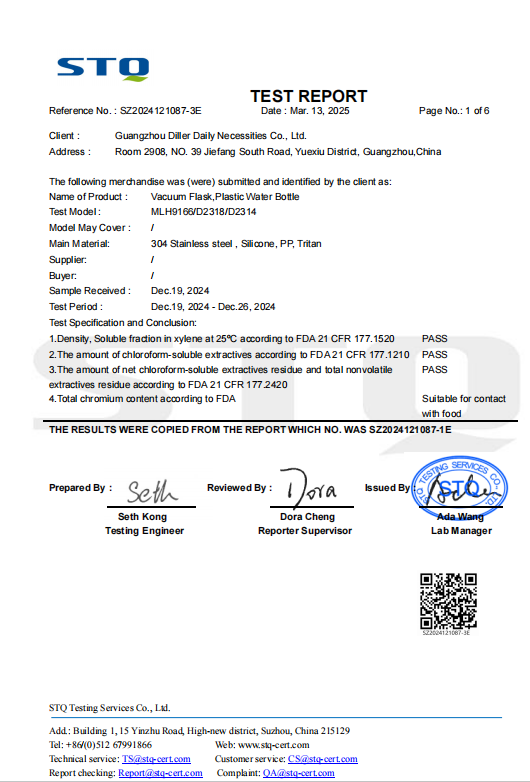
Bottom Line
Water bottle certifications from China are not a bureaucratic hurdle — they are a competitive asset. Consequently, buyers who understand the regulatory landscape will prioritize suppliers who can deliver fully certified products with documentation ready for customs clearance and retail compliance.
The three most important certifications to secure are FDA compliance for the US market, EU Regulation 1935/2004 for Europe, and LFGB certification if you want to compete in Germany or signal premium quality to European buyers. In addition, BPA-free certification, Prop 65 compliance, and ISO quality management credentials add further credibility.
Ready to source certified water bottles from a manufacturer that takes compliance seriously? Learn more about Diller or browse our product catalog. Our team can provide certification documentation and guide you through the requirements for your specific target market.